
Disclosure: This guide has affiliate links — if you buy through one we may earn a small commission at no extra cost to you. Our picks are our own. Full disclosure.
You want a speaker that looks like it belongs on a shelf, not a spec sheet — a chrome dial, a wood cabinet, something with a bit of soul. The problem is that "retro" is mostly a paint job. Plenty of vintage-look speakers sound exactly as thin as they look, and a few genuinely great ones hide behind the gimmicks. This is a researched guide, not a lab test: it's built from manufacturer specs, published reviews from people who measure sound for a living, and the pile of owner feedback that only shows up months after a speaker lands in real homes. Here's the honest read on which retro Bluetooth speakers are worth buying in 2026 — and which trade real sound for the look.
- Best sound + toughest build: the Marshall Emberton II — IP67, 30-hour battery, and it actually fills a room.
- Best genuine radio: the Tivoli Audio Model One BT — a real wood cabinet and a tuner that pulls in weak stations. Pricey.
- Best retro-radio look for the money: the MUZEN OTR Metal — a tiny 1964-radio replica with FM and Bluetooth, around $95.
- Skip the look-only buys: a vintage shell doesn't add bass. Match the speaker to how you'll actually use it.
| Speaker | Best for | Style | Price |
|---|---|---|---|
| Marshall Emberton II | Best sound + rugged | Amp-grille modern-retro | ~$159.99 |
| Tivoli Audio Model One BT | Best genuine radio | Mid-century wood cabinet | ~$179.99 |
| MUZEN OTR Metal | Best retro look for the money | 1964 mini-radio, metal | ~$94.99 |
| We Are Rewind | Cassette nostalgia | '80s Walkman revival | ~$179 |
| Divoom Ditoo-Pro | Most fun / desk piece | Pixel-art arcade | ~$79.99 |
1. Marshall Emberton II — best sound and the toughest of the bunch
Marshall Emberton II
The retro look that also earns its keep on sound and durability — IP67 and a 30-hour battery.
Check price at Marshall →If you want the vintage look and the speaker to actually deliver, this is the one. The Emberton II wears Marshall's amp-cabinet styling — black vinyl wrap, the script logo, a brass-finish control knob — but underneath it's a properly modern portable. Marshall rates it at 30-plus hours of playtime per charge, it carries an IP67 dust-and-water rating (the brand says it survives 30 minutes under a metre of water), and it runs Bluetooth 5.1. At roughly 1.5 lb it's pocket-of-a-coat portable. Reviewers consistently put its sound near the top of its size class: a bigger, more confident output than the dinky retro novelties, with Marshall's "True Stereophonic" trick spreading the sound wider than the box has any right to.
The honest catches: it's the priciest of the truly portable picks here, and the look is retro-flavoured rather than authentically vintage — it reads "Marshall amp," not "your grandparents' radio." There's no speakerphone or 3.5 mm aux either. But if "retro that doesn't compromise" is the brief, start here.
Pros
- Best sound of the group — genuinely room-filling for the size
- IP67 — survives rain, dust, a dunk in the sink
- 30+ hours of battery, USB-C charging
- Built like a tank; the look ages well
Cons
- Most expensive portable here
- No aux input, no speakerphone
- "Amp" styling, not true vintage radio
2. Tivoli Audio Model One BT — best if you want a real radio
Tivoli Audio Model One BT
A handmade wood cabinet, a tuner that finds weak stations, and warm mono sound. The grown-up choice.
Check price at Tivoli Audio →The Model One has looked like this since 2000, and it's barely changed because it didn't need to: a real wood-veneer cabinet, three analog knobs, and a single large speaker tuned for warm, easy listening. The BT version adds Bluetooth 5.1 to the classic AM/FM tuner that built the brand's reputation — Tivoli's calling card is a receiver sensitive enough to clean up the weak stations a cheaper radio drops. This is the pick for someone who wants an actual radio for the kitchen counter that also streams a podcast off their phone, in a cabinet that looks like furniture.
Be clear about what it is, though. It's mono, mains-powered (not a portable you toss in a bag), and at around $180 it's the most expensive speaker on this list. It's also not built to be loud — it's built to sound nice at sensible volume. If you want thump for a party, look elsewhere. If you want a beautiful object that does radio properly, this is it.
Pros
- Genuine handmade wood-veneer cabinet — looks like furniture
- Excellent AM/FM tuner; pulls in weak stations
- Warm, natural sound at normal listening levels
- Dead-simple three-knob operation
Cons
- Most expensive pick here
- Mono, and mains-powered — not portable
- Not built to play loud
3. MUZEN OTR Metal — best retro-radio look for the money
MUZEN OTR Metal
A palm-sized 1964-radio replica with a real metal body, FM and Bluetooth — pure desk charm, modest bass.
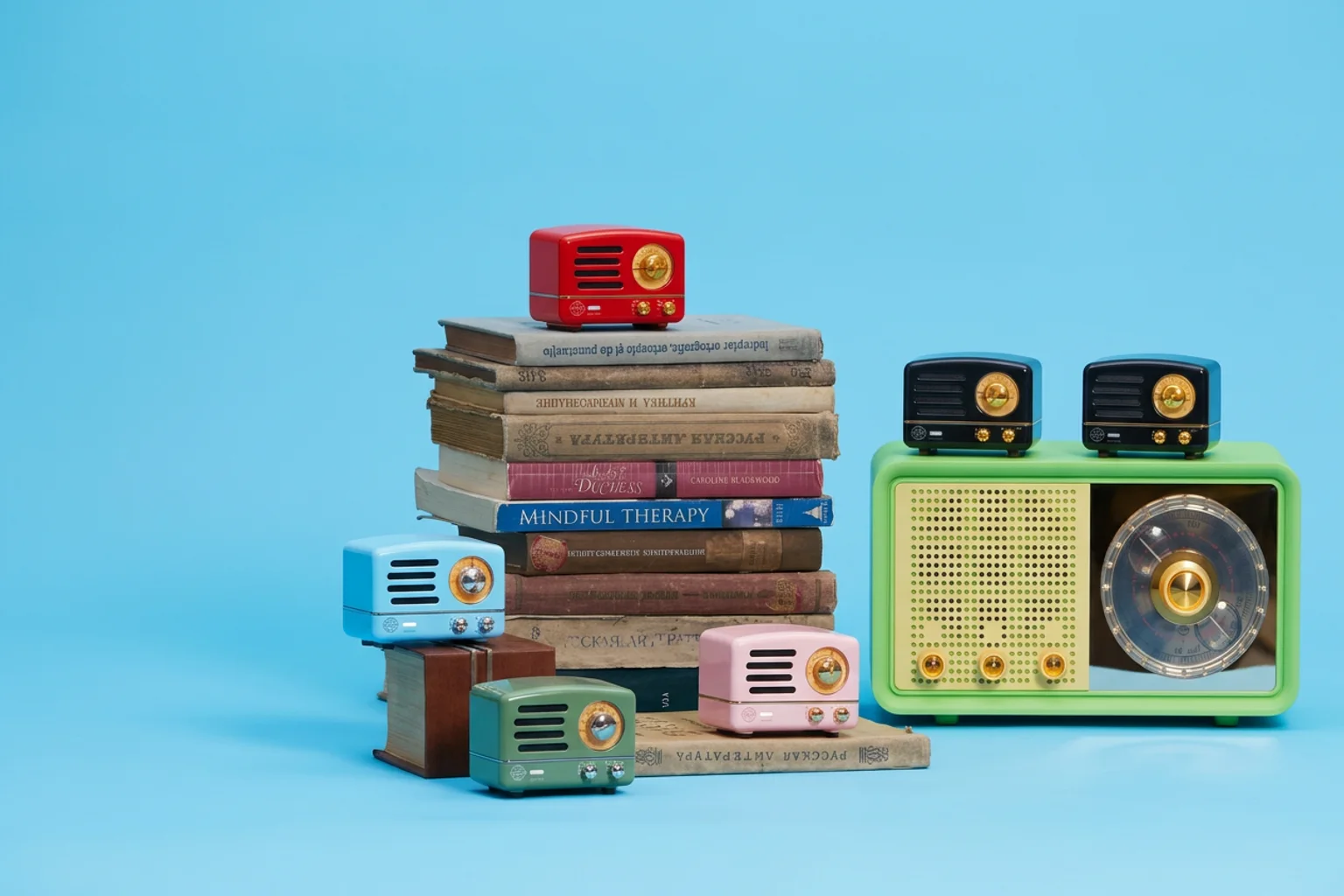
Check price at MUZEN →If what you're really after is the look — the most charming little object on the shelf — the OTR Metal is the value play. It's a palm-sized homage to a 1964 transistor radio: a single-piece metal body, an amber tuning window, and a working FM radio alongside Bluetooth 5.0 and a 3.5 mm aux input. It even ships in a small retro carrying case, which is why it lands under so many Christmas trees. MUZEN won a CES Innovation Award for it, and the design genuinely earns the attention.
Now the honest part, because this is where the marketing oversells. It's tiny — under a pound, with a single 5W driver — so expect clear, room-filling sound for one person at a desk or on a nightstand, not deep bass or party volume. The brand's own copy leans on "bass-heavy," and that's the one claim I'd push back on: physics doesn't give a speaker this small real low end. Battery is rated up to 10 hours at moderate volume. Take it for what it is — a delightful, well-built design object that happens to play music — and it's hard not to like. For the full rundown, see our MUZEN OTR Metal review.
Pros
- The most charming retro look here — and a real metal body, not plastic
- Working FM radio + Bluetooth + aux in one tiny package
- Cheapest of the "real radio look" picks at around $95
- Ships in a retro case — ready to gift
Cons
- Small single driver — clarity over bass, no party volume
- "Bass-heavy" marketing oversells what the size can do
- No water resistance rating stated
4. We Are Rewind — best for cassette nostalgia
We Are Rewind Portable Cassette Player
A modern Walkman with Bluetooth out — proper '80s nostalgia, but it's a tape player, not a speaker.
Check price at We Are Rewind →This one's a curveball, and it's here for the person who wants nostalgia you can hold. We Are Rewind makes a modern reissue of the cassette Walkman — anodized aluminium body, USB-C charging, a rechargeable battery rated around 12 hours, and, crucially, Bluetooth 5.1 so you can pipe a tape out to wireless headphones or a speaker without a cable. It even records. If you (or a gift recipient) still have a shoebox of mixtapes, nothing else on this list scratches that itch.
The big caveat: this is a cassette player, not a Bluetooth speaker. There's no built-in speaker worth mentioning — the Bluetooth sends audio out, it doesn't play a room. And it only does what cassettes do: no streaming Spotify, no radio. At roughly $179 it's a deliberate, niche, lovely thing. Buy it because you love tapes, not because you need a speaker.
Pros
- The real deal for cassette fans — plays and records tapes
- Bluetooth 5.1 out to headphones or a speaker
- Solid aluminium build, USB-C, ~12-hour battery
Cons
- It's a tape player, not a speaker — no real built-in sound
- Cassettes only; no streaming or radio
- Pricey for a single-purpose gadget
5. Divoom Ditoo-Pro — best for desk fun
Divoom Ditoo-Pro
A pixel-art LED screen, retro-arcade looks and app gimmicks — more toy than hi-fi, and that's the point.
Check price at Divoom →The Ditoo-Pro reaches for a different kind of retro — 8-bit, not mid-century. It's a small Bluetooth speaker shaped like a chunky little computer, with a 16×16 LED front panel you program from an app: pixel-art animations, a clock, the song title, even tiny games. It's a desk companion as much as a speaker, with a 15W output that's louder than the MUZEN, plus USB-C and a card slot. For a teenager's room or a playful desk, it's genuinely fun and the cheapest pick here at around $80 on sale.
Manage expectations on two fronts. Sound is fine-for-the-price, not a reason to buy it — you're paying for the screen and the novelty. And the app is where the magic lives, which means the experience leans on software that can feel cluttered. As a joyful object it delivers; as a serious listening speaker, the Marshall walks all over it.
Pros
- Customisable pixel-art LED screen — genuinely fun
- Louder than the small retro-radio picks (15W)
- Cheapest pick here; great for a desk or kid's room
Cons
- Sound is fine, not great — you're buying the screen
- App-dependent and can feel cluttered
- "Retro" here means 8-bit, not vintage
How to choose a retro Bluetooth speaker
The trap with this whole category is buying the photo. Here's how to make sure the thing that arrives is the thing you actually wanted.
Decide what "retro" means to you. It splits three ways: a mid-century wood radio (Tivoli), a metal mini-radio replica (MUZEN), or a styled-modern look like a Marshall amp. There's also 8-bit retro (Divoom) and tape-era nostalgia (We Are Rewind). Picture it on your actual shelf before you pick a lane.
Be realistic about sound — especially bass. A small enclosure can't move much air, so a tiny speaker physically can't produce deep bass, no matter what the listing says. Smaller retro picks like the OTR Metal are about clarity and room-filling presence for one or two people, not thump. If you want fuller sound and volume, you need a bigger box like the Emberton — or you accept the trade for the looks. When a product page promises "bass-heavy" from something palm-sized, treat it as marketing.
FM radio, or Bluetooth-only? Some of these are genuine radios with Bluetooth bolted on (Tivoli, MUZEN); others are Bluetooth speakers with a vintage shell and no tuner (Marshall, Divoom). And read the fine print: the lovely Roberts Revival radios, for instance, look the part but many models have no Bluetooth at all. If you want to catch a local station during a power cut or just like spinning a dial, prioritise a real tuner.
Size and portability. Mains-powered furniture pieces (Tivoli) stay put. Battery picks (Marshall, MUZEN, Divoom) travel. If it's going in a bag or out to the garden, check the battery hours and whether there's any water resistance — only the Marshall here carries a real IP rating. And if it's going in a suitcase, relax: every pick here clears airline battery rules with room to spare — the details are in our guide to bringing a Bluetooth speaker on a plane.
Mounting beats sitting, in some rooms. If the speaker's real home is a fridge door or a workshop shelf, a built-in magnet changes the buying logic entirely — we ranked those separately in our guide to magnetic Bluetooth speakers, where MUZEN's $30 OTR Sticker is the fridge pick.
Set a budget and match it to the job. Roughly $80 buys novelty and charm (Divoom, MUZEN). Around $160–180 buys either the best sound (Marshall) or a proper furniture-grade radio (Tivoli). Spend where the thing you care about lives — don't pay radio money for a speaker you'll only stream to.
Do retro Bluetooth speakers actually sound good?
It depends entirely on the speaker, not the styling. A larger one like the Marshall Emberton II sounds genuinely good and fills a room. Small mini-radio replicas trade real sound for the look — expect clear audio at moderate volume for one or two people, not deep bass or party levels.
Which retro speaker has the best sound?
For portable, room-filling sound the Marshall Emberton II leads this group — reviewers consistently rate it near the top of its size class. For warm, natural listening from a real radio at sensible volume, the Tivoli Audio Model One BT is the standout, though it's mono and not built to play loud.
Does the MUZEN OTR Metal have good bass?
No, and you shouldn't expect it to. It's a palm-sized speaker with a single 5W driver, so it delivers clarity and room-filling presence rather than deep bass. The brand's "bass-heavy" wording oversells what a speaker that small can physically produce. Buy it for the design and the FM radio, not the low end.
Are these speakers actual radios, or just Bluetooth?
Some are both. The Tivoli Model One BT and the MUZEN OTR Metal have genuine FM tuners alongside Bluetooth. The Marshall Emberton II and Divoom Ditoo-Pro are Bluetooth-only with retro styling. And watch out — some vintage-look radios, like several Roberts Revival models, ship with no Bluetooth at all, so check before you buy.
What's the best retro speaker to give as a gift?
The MUZEN OTR Metal is the easiest gift here — it's around $95, ships in a retro carrying case, and the 1964-radio look earns a reaction before it's even switched on. For a cassette-loving recipient, the We Are Rewind player is a memorable, niche choice. For a teenager's desk, the playful Divoom Ditoo-Pro fits. And if the recipient's nostalgia runs wider than speakers, our retro tech gift guide covers cameras, turntables and more.
Can I use a retro Bluetooth speaker outdoors?
Only if it's rated for it. Of these picks, only the Marshall Emberton II carries a water-and-dust rating (IP67), so it's the one you can take to the beach or leave out in a drizzle. The wood-cabinet and metal-radio styles are indoor objects — keep them off the patio table when rain threatens.