
Disclosure: This article has a couple of affiliate links — if you buy through one we may earn a small commission at no extra cost to you. The rules and advice here are not for sale. Full disclosure.
Short answer: yes. The TSA allows Bluetooth speakers in both carry-on and checked bags — its own "What Can I Bring" entry for speakers is a flat yes on both counts. The rule that actually decides where your speaker should ride isn't about the speaker at all — it's about the lithium-ion battery inside it, and that rule comes from the FAA. Under 100 watt-hours (Wh), which covers nearly every portable speaker ever made, you're fine. This piece is researched from the TSA and FAA's own pages (checked June 2026, both linked so you can verify), and it gives you the three numbers that matter, the one packing mistake that gets bags pulled, and the quick math to check your own speaker.
- TSA says yes to both bags. Speakers are allowed in carry-on and checked luggage — the only TSA caveat is that big ones must fit the overhead bin or under the seat.
- The FAA's battery tiers decide the details: lithium-ion up to 100 Wh flies freely; 101–160 Wh needs airline approval; over 160 Wh is forbidden on passenger flights.
- Carry it on anyway. A checked speaker must be completely powered off and protected from switching itself on — and spare batteries or power banks are never allowed in checked bags.
- Almost no speaker comes close to the limit. A typical 1,900 mAh travel speaker works out to about 7 Wh — roughly 7% of the allowance.
What the TSA actually says
The TSA's official answer is short enough to quote in full. On its What Can I Bring page, "Speakers" gets a Yes for carry-on bags and a Yes for checked bags. The only condition attached: "For items you wish to carry on, you should check with the airline to ensure that the item will fit in the overhead bin or underneath the seat of the airplane." That's a size note, not a security one — your pocket speaker is irrelevant to it, your suitcase-sized party box is not. The page also carries TSA's standard footer: the final decision rests with the officer at the checkpoint. In practice, for a normal Bluetooth speaker, that decision is a wave-through.
One thing worth knowing for the security line itself: in standard lanes, TSA's screening procedures say you'll be asked to remove "personal electronic devices larger than a cell phone" from your carry-on and put them in a bin, with nothing on top of them. A small speaker often sails through inside the bag, but if yours is bigger than a phone, have it ready to go in a bin — it saves you the bag re-run.
The battery rule that actually matters
Security isn't worried about your speaker playing music; it's worried about lithium-ion batteries overheating in places where nobody can reach them. That's FAA territory, and the FAA's PackSafe rules for lithium batteries sort everything into three tiers by watt-hours:
Up to 100 Wh: allowed, no airline approval needed, and no quantity limit as long as the batteries are for your own use. 101–160 Wh: allowed only with airline approval, and capped at two spares that size per person. Over 160 Wh: forbidden on passenger aircraft, full stop. Per the FAA, these limits cover "nearly all types of lithium batteries used by the average person in their electronic devices."
For perspective: 100 Wh is laptop-battery territory. Portable Bluetooth speakers sit far, far below it — most small ones are 4–10 Wh, and even big boomboxes rarely break 100. Unless you're hauling professional PA gear, the limit is a formality. The tier system only becomes real if you fly with something like a giant party speaker with a removable pack, and we cover that in the FAQ below.
Spare (uninstalled) lithium batteries and power banks must travel in carry-on baggage only — never checked. The FAA is explicit, and this includes the gotcha: if your carry-on gets gate-checked at a full flight, you must pull the power bank and spares out and keep them with you in the cabin. Battery terminals also need protecting from short circuit — retail packaging, tape over the contacts, or a pouch all count.
Why so strict about the cabin? The FAA's passenger battery guidance spells it out: lithium-ion batteries can overheat into thermal runaway, and flight crews are trained to spot and handle a battery fire in the cabin. In the cargo hold, nobody's watching. That's also why the speaker itself — battery installed — is happier in your carry-on, even though checking it is technically allowed.
Carry-on or checked? Carry it on.
Here's the precise FAA wording for devices with the battery built in: rechargeable lithium battery-powered devices "can be checked only if they are completely powered off and protected from accidental activation" — and they still have to meet the watt-hour tiers above. Completely off means off, not sleep mode, and "protected from activation" means packed so a shifting suitcase can't press the power button for six hours.
So the practical decision tree is short. Carry-on: drop it in your bag and go — that's the FAA's preferred place for anything with a lithium battery, and it doesn't hurt that baggage handlers never meet your speaker. Checked: allowed, but power it fully off, wrap it so the button can't be pressed, and accept the small risks of the hold (heat, crushing, theft). And whichever bag the speaker rides in, any separate power bank or spare battery rides with you in the cabin. No exceptions to that one.
The watt-hour math, honestly
Speaker spec sheets love milliamp-hours (mAh) and the rules are written in watt-hours (Wh), so here's the conversion, straight from the FAA's own guidance: Wh = volts × amp-hours. If your battery is listed in mAh, divide by 1,000 to get amp-hours first. The FAA's example: a 12-volt battery rated at 8 Ah is 96 Wh.
Two real speakers, using their published battery capacities at the 3.7 V that single-cell lithium-ion batteries typically run: a MUZEN OTR Metal with its 1,000 mAh cell is 1 Ah × 3.7 V ≈ 3.7 Wh. A MUZEN Wild Mini 3.0 with a 1,900 mAh cell is about 7 Wh. To even reach the 100 Wh line at 3.7 V, a speaker would need a 27,000 mAh battery — that's a car-jump-starter-sized cell, not a speaker. One honest caveat: bigger speakers sometimes use multi-cell packs at 7.2 V or 11.1 V, which multiplies the Wh, so don't assume — newer batteries usually print the Wh rating right on the label, and that number wins over any math.
Can you actually use it during the flight?
Two different questions hide in there. First: is Bluetooth allowed in the air? That's your airline's call, not the TSA's — most carriers now permit short-range Bluetooth accessories (headphones, mostly) once your phone is in airplane mode, but policies vary, so check yours if it matters to you. Second: can you play music out loud in the cabin? Technically nothing in TSA or FAA rules stops you. Practically, the crew will, and quickly — a metal tube full of strangers is the one place a speaker has no social license at all. Use headphones in the air. The speaker is for the hotel room, the beach, and the layover lounge where nobody else is trapped with your playlist.
Flying internationally? Mostly the same — check the airline
The 100 Wh / 160 Wh tiers aren't an American quirk; they come from the international dangerous-goods framework most countries and carriers adopt, so the same numbers greet you nearly everywhere. The thing that genuinely varies is airline policy on top — several international carriers have tightened power-bank rules recently (limits on how many you can carry, and in some cases bans on using them mid-flight). Before an international trip, spend two minutes on the restricted-items page of each airline you're flying, not just the first leg. The FAA's own pages note that both domestic and international airlines may set stricter limits than the baseline.
What makes a speaker travel-friendly
After all the rules, the actual buying logic is simple: small and light enough to never argue with the overhead-bin note, an installed battery in single-digit watt-hours, USB-C so it shares your phone charger, and ideally a case so it survives the bag. A water-resistance rating helps if your trips end at a pool or a trailhead. That profile describes most of the small picks in our retro Bluetooth speakers guide, but two we keep coming back to for travel specifically:
MUZEN OTR Metal
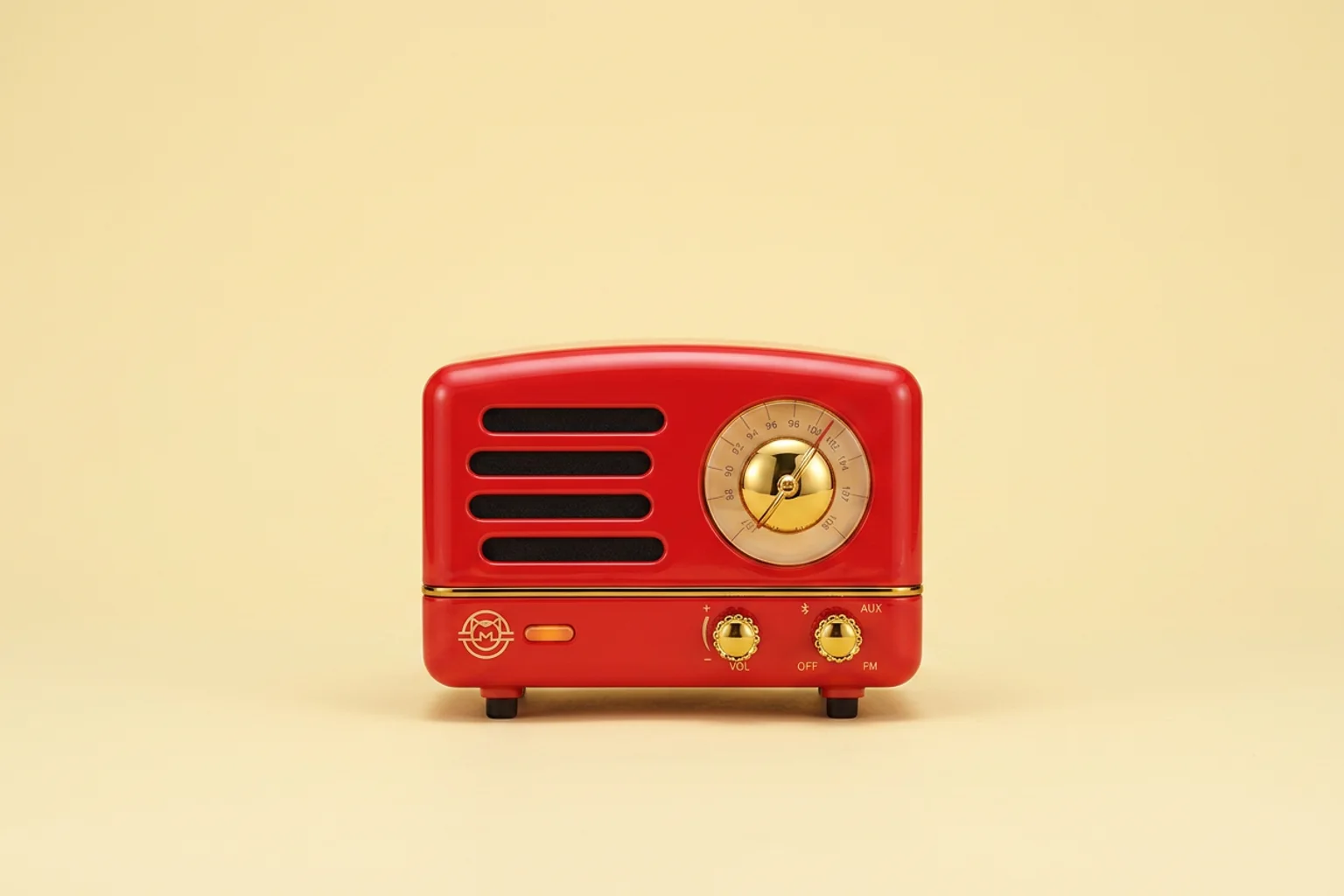
A palm-sized metal speaker with a ~3.7 Wh battery — about 4% of the FAA limit — that weighs under a pound, charges over USB-C and ships in its own retro travel case. Clarity over bass, and it packs like a paperback.
Check price at MUZEN →The OTR Metal earns the travel slot on packability: 436 g, a hard retro case, a real FM radio for places with no signal, and a battery so small the rules become irrelevant. It's not the one for bass — we're upfront about that in our full OTR Metal review — but as a hotel-room and Airbnb speaker that disappears into a carry-on, it's an easy pack. If your trips lean outdoors instead, the MUZEN Wild Mini 3.0 (~$109.99) is the ruggedized take: IPX5 water resistance, Bluetooth 5.3, a 1,900 mAh battery rated up to 15 hours, and it doubles as a power bank for your phone. That last feature comes with a rule attached — anything that charges other devices should ride in the cabin, since the FAA treats portable chargers as carry-on-only items. Check price at MUZEN →
Before you fly: the 2-minute checklist
- Find your speaker's watt-hours. Check the label first — newer batteries print the Wh. If it only lists mAh: divide by 1,000, multiply by the voltage. Under 100 Wh (it almost certainly is), you're clear.
- Default to carry-on. It's the FAA's preferred spot for lithium batteries and the safer one for your gear. If it's bigger than a phone, be ready to bin it separately at standard screening lanes.
- Checking it instead? Power it fully off — not sleep — and pack it so nothing can press the power button in transit.
- Put every spare battery and power bank in your carry-on. Tape or pouch the terminals. If your bag gets gate-checked, pull them out and take them to your seat — that's the rule, not a suggestion.
- Check your airline's page for in-flight Bluetooth policy and, on international trips, for stricter battery limits on every leg.
Frequently asked questions
Can you put a Bluetooth speaker in a checked bag?
Yes — TSA allows speakers in checked bags, and the FAA permits devices with installed lithium-ion batteries under 100 Wh in the hold as long as they're completely powered off and protected from switching on accidentally. Still, the FAA's guidance favors the cabin for anything with a lithium battery, and the cargo hold is rougher on gear. Carry it on if you can. Spare batteries and power banks can never be checked.
Can you bring a big party speaker on a plane?
Usually yes, but two checks apply. First, the battery: under 100 Wh flies freely, 101–160 Wh needs your airline's approval, and over 160 Wh is forbidden on passenger flights — check the label or the manufacturer's spec page. Second, the size: TSA's speaker entry tells you to confirm with the airline that a carry-on item fits the overhead bin or under the seat. Many party speakers only fit as checked bags, in which case they must be fully powered off and packed against accidental activation.
Do AirPods and other wireless earbuds follow the same rules?
Same framework, no practical worry. Earbuds and their charging cases contain tiny lithium-ion batteries — fractions of a watt-hour to a few watt-hours — nowhere near the 100 Wh line. The case counts as a device with an installed battery, so it's fine in either bag, though like all lithium batteries it's better off in your carry-on. A separate power bank for charging them is carry-on only.
Can you actually play a Bluetooth speaker during the flight?
Connecting via Bluetooth is generally allowed once you're in airplane mode — most airlines permit short-range Bluetooth accessories, though policies vary by carrier. Playing music out loud is a different story: no rule book needs to ban it, because the cabin crew will. Treat the speaker as luggage in the air and a speaker on the ground.
How do I find my speaker's watt-hours if the label doesn't say?
Use the FAA's formula: watt-hours = volts × amp-hours. If the battery is listed in mAh, divide by 1,000 to get amp-hours first, then multiply by the voltage. Example: a 1,900 mAh battery at 3.7 V is about 7 Wh. If you can't find the voltage, the manufacturer's spec page usually lists it — and on most newer batteries the Wh rating is printed directly on the cell.
Are speaker batteries treated differently from drone or camera batteries?
The watt-hour tiers are identical — the FAA doesn't care what the battery powers. The practical difference is spares: drone and camera kits usually involve spare (uninstalled) batteries, which must go in carry-on with their terminals protected, while a speaker's battery is typically built in, which is why a powered-off speaker can legally go in a checked bag when a loose drone battery can't.
Are the rules different on international flights?
The same 100 Wh and 160 Wh thresholds apply nearly everywhere, because they come from the international dangerous-goods standards most countries adopt. What changes is airline policy on top of them — some international carriers cap how many power banks you can carry or restrict using them in flight. Check the restricted-items page of every airline on your itinerary, not just the first one.
Do I have to take the speaker out of my bag at security?
In standard TSA lanes, you'll be asked to remove personal electronic devices larger than a cell phone and place them in a bin with nothing on top. A phone-sized speaker usually stays in the bag; anything bigger, plan to bin it. TSA PreCheck lanes generally let electronics stay packed, and either way the officer's instructions are the final word.
Bottom line: yes, your Bluetooth speaker flies — TSA clears it for both bags, and the FAA's 100 Wh battery limit is roughly ten times what a typical portable speaker carries. Keep it in your carry-on, keep any power bank in the cabin with it, do the thirty-second watt-hour check if you own something huge, and save the actual listening for the other side of the jet bridge. If you're still picking the speaker that's coming with you, start with our retro Bluetooth speaker guide — and if it's for someone else's travels, the small picks in our retro tech gift guide pack just as light.